Category:
Rio de Janeiro City Hall presents Santa Cruz Mobility Plan.
Published on 23/08/2026 - 15:41 | Updated on 23/08/2026 - 19:38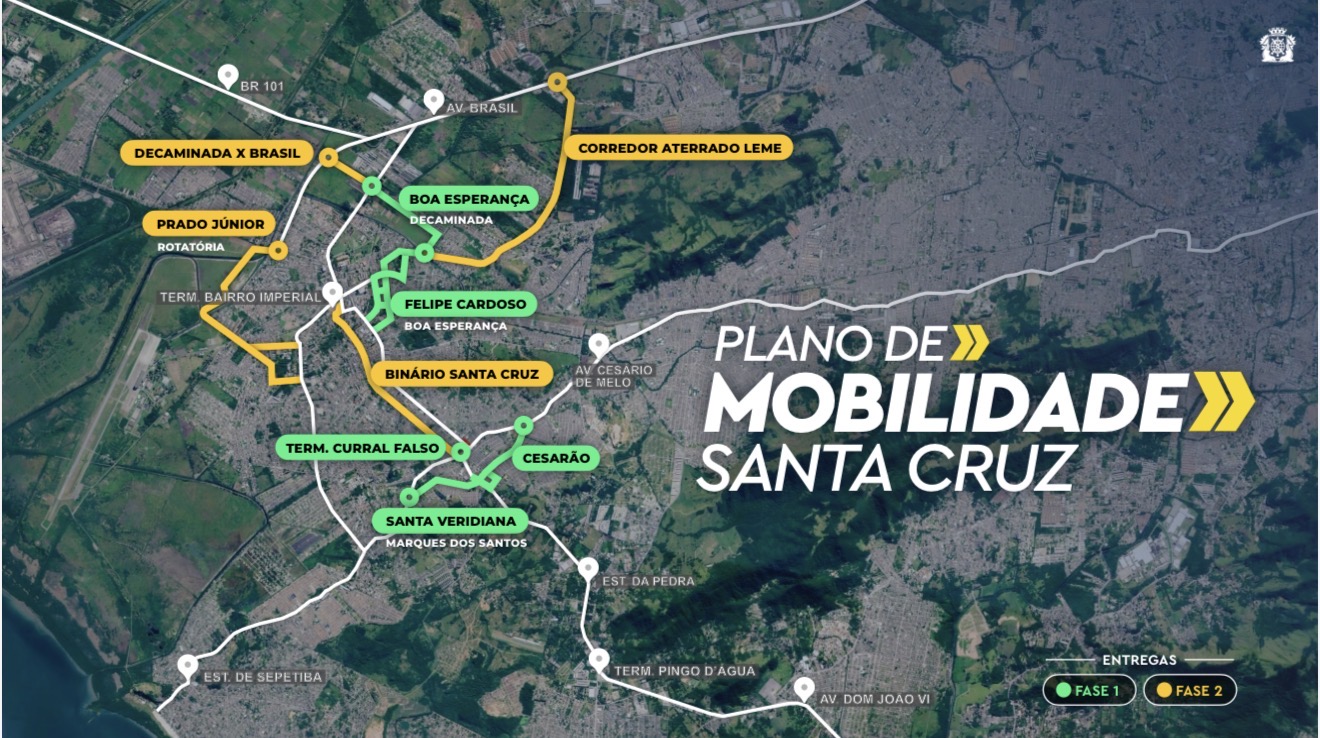 The set of projects includes more than 70 kilometers of interventions - Press Release
The mayor of Rio, Eduardo Cavaliere, announced this Sunday (August 23rd) the Santa Cruz Mobility Plan, a set of projects to create new connections, reorganize intersections and access points, and improve the movement of vehicles, pedestrians, and the BRT (Bus Rapid Transit). In total, there will be more than 70 kilometers of interventions to reduce the main traffic bottlenecks in the neighborhood, with an initial investment of R$ 443 million. The model follows the same pattern as what is being implemented in Campo Grande.
Mayor Eduardo Cavaliere presented the plan in the auditorium of the Roberto Rocca Technical School in Santa Cruz, which was packed with an audience mostly composed of residents of the neighborhood.
– We are talking about projects similar to those done in the Campo Grande Mobility Plan. Now, we are presenting a Mobility Plan for Santa Cruz. I would also like to remind you that we have already completed 70% of the work on the BRT Intermodal terminal in the center of Santa Cruz, and we have a significant number of new buses – he said.
With approximately 250 inhabitants, Santa Cruz is the second most populous neighborhood in Brazil – second only to its neighbor, Campo Grande – and encompasses large residential areas, an important industrial hub, as well as commerce, services, and healthcare facilities. This diversity generates intense daily traffic and increases demand on the region's main thoroughfares. To improve mobility, the plan developed by the Municipal Infrastructure Secretariat includes short- and medium-term actions.
The municipal secretary of Infrastructure, Wanderson Santos, highlighted the importance of Santa Cruz when justifying the choice of the neighborhood for the announced road closures:
– Santa Cruz is larger than 96% of all municipalities in Brazil. And if Santa Cruz were a city in our state, it would be in the top 10. These interventions will allow us to reorganize the spaces, which will increase the quality of their use.
In the first phase, interventions will be concentrated in high-traffic areas, such as the Curral Falso terminal and the area surrounding the Doze de Outubro Viaduct, which is already under development. Currently, those coming from Campo Grande via Avenida Cesário de Melo and needing to return in the opposite direction pass through the roads surrounding the Curral Falso Terminal, which become congested at certain times. To alleviate this section, the first intervention will be the implementation of a U-turn on Cesário de Melo, near the Otacílio Câmara Housing Complex (Cesarão). This solution will allow drivers to make the turn before reaching the terminal, better distributing traffic. The project also reorganizes pedestrian crossings to increase safety in the area.
Cesarão will gain a new route. Another intervention will create a new connection between Estrada da Pedra and Avenida Cesário de Melo, passing through Cesarão. The goal is to offer drivers another alternative and reduce traffic flow around Curral Falso. The project also includes bike paths and urbanization along one of the main stormwater drainage channels in the region.
On Estrada da Pedra, the area surrounding the Santa Veridiana BRT station will also be reorganized. The project includes an elongated roundabout and the requalification of Rua Marquês dos Santos, with new sidewalks and bike paths. The change will open a new access option to Estrada de Sepetiba without the need to pass through Curral Falso. This will allow some vehicles to use other routes, while access to Avenida Cesário de Melo via Cesarão will become more direct. The new traffic flow will be complemented by changes at the intersection of Estrada de Sepetiba and Rua Marquês dos Santos.
The neighborhood will gain two new overpasses over the railway line. This part of the plan will connect Rua Felipe Cardoso to Estrada da Boa Esperança, creating an alternative route for drivers and helping to alleviate traffic in the center of Santa Cruz. The new overpasses over the railway line will be located near Rua Marquês de Barbacena and Rua Álvaro Alberto. There will also be new bike paths, and the sidewalks will be upgraded.
Mayor Eduardo Cavaliere highlighted, among many other important points, the positive impact the plan will have on downtown Santa Cruz:
"We are including in the plan, so that people have more alternatives in the city center, two new overpasses, including a new road, so that everyone who travels by car and bus doesn't always have to use the same roads. Because we have alternatives for moving around within the neighborhood," he emphasized.
The Estrada da Boa Esperança will also gain a connection to Avenida Padre Guilherme Decaminada. The new route will allow drivers to avoid passing through Rua Senador Camará and Praça do Gado, sections with heavy traffic during peak hours. Approximately two kilometers long, the connection will include roundabouts, a bike path, new sidewalks, and a bridge over the Rio Cação Vermelho. Together, the two new connections will form an alternative route and facilitate access to Avenida Brasil.
Professor Milena Zoio, 42, has lived in Santa Cruz since she was born and knows the difficulties of the place better than anyone.
"In recent years, traffic in Santa Cruz has become impossible. The main avenues leading to the neighborhood are very chaotic, making it difficult to navigate both by car, public transport, and on foot. The neighborhood center is also quite bad. We hope to have more ease as pedestrians and as drivers. There are routes that we used to be able to do in ten minutes and that now take more than an hour, an hour and a half. Many times, people have a car but prefer to walk, precisely because of this difficulty. I believe that this mobility plan will be providential in Santa Cruz," he said.
New connections to Santa Cruz in the second phase.
In addition to priority actions, the City Hall is working on projects to expand Santa Cruz's connections with Avenida Brasil, strengthen the BRT operation, and create new routes for travel within the neighborhood.
The neighborhood will gain the new Santa Cruz Binary system, with a new direction to reorganize traffic, reduce congestion, and increase fluidity in the neighborhood's center.
Other improvements will include the corridor between Estrada da Boa Esperança and Estrada Aterrado do Leme. This will encompass four kilometers of improvements, with renovated lanes, new sidewalks, and a bike path. All of this will facilitate travel in the region.
The neighborhood will also gain a new exit to Avenida Brasil. With 800 meters of new road construction between Avenida Padre Guilherme Decaminada and Avenida Brasil, residents will have greater ease of access to and from the neighborhood.
It will also be faster to travel from the center of Santa Cruz to Avenida Brasil, with improvements to the connection between Avenida João XXIII and Avenida Brasil and Rua Prado Junior. There will be a new roundabout providing access to Avenida Brasil, as well as a new route to Itaguaí and the Costa Verde.
Santa Cruz gets a new BRT terminal.
Currently under construction on Rua Álvaro Alberto, the Bairro Imperial Santa Cruz BRT Terminal will have approximately 14 square meters of built area, distributed over three floors, and will serve as a new integration point between the BRT and conventional buses.
With an investment of R$ 73,7 million, the structure will have the capacity to accommodate up to 14 articulated buses, ten conventional buses, and minibuses. The terminal will also feature boarding and disembarking platforms, circulation areas, shops, parking, and bicycle parking.
The project by the Municipal Infrastructure Department also includes exclusive lanes for the BRT and interventions on Felipe Cardoso, Barão de Laguna, and Dom Pedro I streets to organize traffic flow in the surrounding area. The terminal is expected to be completed in the second half of 2027.
The model is similar to that of Campo Grande, which is undergoing the biggest road transformation in its history.
With over 350 residents, Campo Grande is the most populous neighborhood in Brazil. To keep pace with the region's growth and address long-standing mobility bottlenecks, the Rio de Janeiro City Hall is also maintaining a wide range of infrastructure projects in the neighborhood. The Campo Grande Mobility Plan includes new connections, tunnels, underpasses, and road improvements. These interventions also benefit residents of Santíssimo and Paciência and expand connections to Avenida Brasil and other corridors in the West Zone.
Among the main projects delivered is the first tunnel in Campo Grande's history, the Professor Moacyr Sreder Bastos Tunnel, which connects Estrada da Caroba to Estrada da Posse. Inaugurated in March 2026, it is part of the first phase of the Ring Road and reduced travel time between the two regions during peak traffic hours from approximately 15 to 3 minutes. This phase also included the underpass beneath Avenida Cesário de Melo, as well as the revitalization of Rua Artur Rios and the upgrading of Estrada da Caroba.
The new access ramp on Estrada dos Sete Riachos, connecting to Avenida Brasil, the Praça Ana Maria da Silva, and the expansion of Estrada do Tingui to Avenida Brasil, which created a new entry and exit option for the neighborhood, have also been completed.
Construction continues at various points in the region.
The second phase of the Ring Road will connect Estrada da Posse to Avenida Brasil via the complex's second tunnel, forming a direct axis between the center of Campo Grande and Avenida Brasil. Also underway are the duplication and widening of Estrada do Lameirão, in Santíssimo, and interventions on Estrada do Monteiro, Avenida Cesário de Melo, Avenida Joaquim Magalhães, Largo da Maçonaria, and Estrada do Mendanha.
The project also includes the Rio-São Paulo Highway dual carriageway at the intersection with Rua Vitor Alves. The works expand traffic alternatives, reorganize high-traffic areas, and include improvements to drainage, paving, sidewalks, and cycling infrastructure. Completion of these projects is scheduled for the second half of 2026.
News
CET-Rio announces scheduled road closures for this Monday (October 5th).
October 5th, 2026
The Reviver Cinema program reopens the Odeon cinema in Cinelândia.
October 5th, 2026
The city of Rio de Janeiro generated 13 formal jobs in August.
October 5th, 2026Rio operates with weekday bus fleet this Sunday of the election.
October 4th, 2026