Category:
Rio System: 115 new buses delivered in Santa Cruz
Published on 23/08/2026 - 15:48 | Updated on 23/08/2026 - 15:49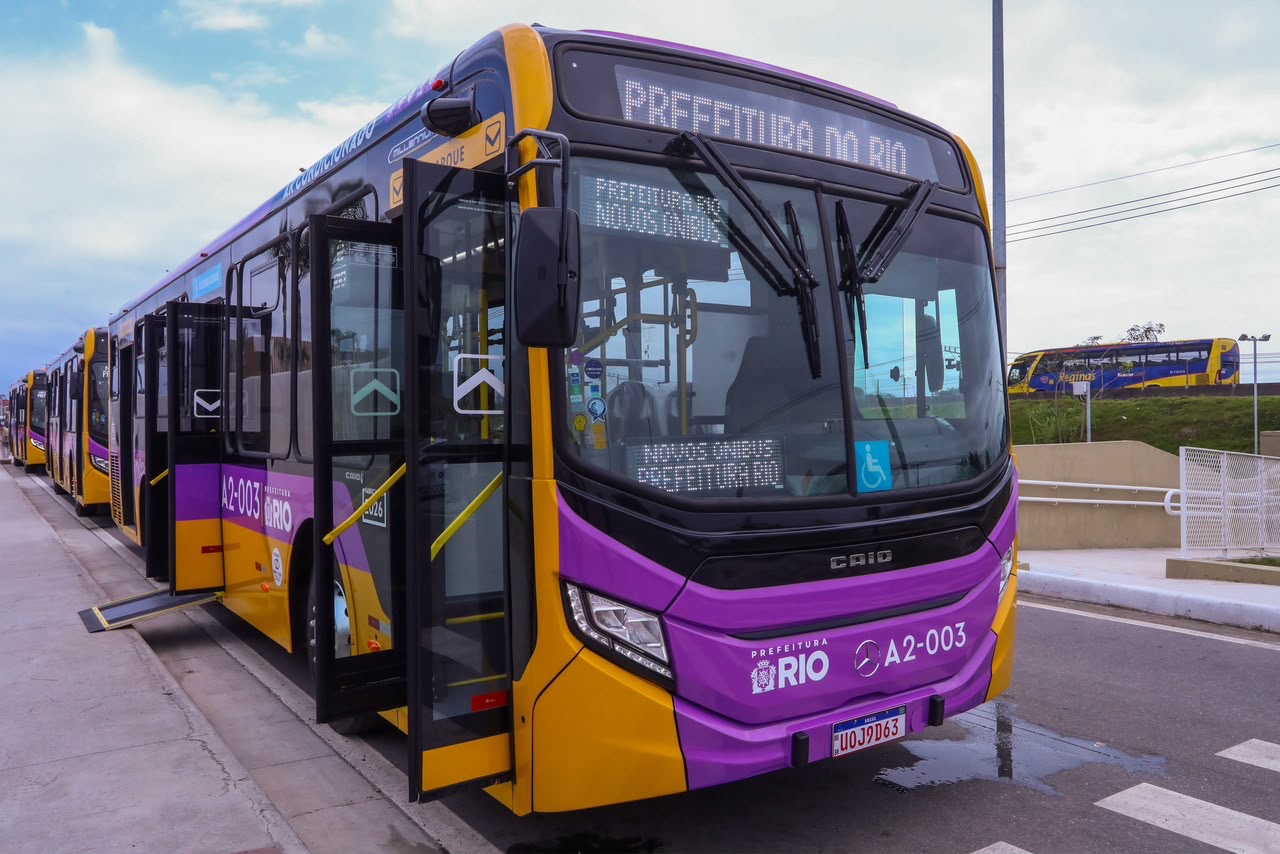 The 115 new vehicles will begin circulating in the region starting this Monday - Rafael Catarcione / Rio City Hall
The Rio de Janeiro City Hall delivered, this Sunday (August 23), the first 115 buses of the RIO System in Santa Cruz, continuing the implementation of the new municipal public transport model in the West Zone. The new vehicles will begin circulating in the region starting this Monday (August 24). Mayor Eduardo Cavaliere and the Municipal Secretary of Transport, Jorge Arraes, attended the presentation of the vehicles that will expand and improve service to the population of Santa Cruz and neighborhoods in the region.
Mayor Eduardo Cavaliere, who rode around Santa Cruz in one of the new buses, highlighted the importance of the delivery:
"We are here delivering 115 new buses, with low floors, air conditioning, GPS, and voice announcements of stops. We will carry out the same transformation with the regular bus lines that was done in recent years with the BRTs. We are starting where it was most needed, in Santa Cruz, moving on to Campo Grande and then continuing to renew the bus fleet throughout the city," he said.
The new vehicles are part of another phase of the RIO System and have been incorporated to expand and renew the fleet serving the region. The Santa Cruz operation will be identified by the predominance of the color purple in the visual identity of the buses. Among the new features are the accessibility features of the basic models, which have a low floor, access ramp and kneeling system, which reduces the height of the vehicle to facilitate boarding and disembarking.
The new fleet includes three models – basic, midi, and minibuses – equipped with air conditioning, USB ports, electronic panels, and safety systems. The vehicles also feature GPS, telemetry, and Intelligent Transportation Systems (ITS), allowing the City Hall to monitor operations in real time and track trips and service quality indicators.
First lines of the RIO System
In total, there are 11 lines – five of which will have route changes to expand service in the region:
804 — False Curral Terminal – Campo Grande
807 — Jesuits – False Curral Terminal
825 — Jesuits – Campo Grande
840 — São Fernando – Campo Grande
849 — Santa Cruz Air Base – Campo Grande
898 — Sepetiba – Campo Grande
Routes with altered itineraries
809 — Leme Landfill – Liberdade Complex
The line, which currently operates on the Sagrado Coração x Santa Cruz route, will have its itinerary extended to connect Aterrado do Leme to Conjunto Liberdade, in Santa Cruz. The new route will also expand service to Avenida João XXIII and Conjunto Guandu.
842 — Santa Cruz – Campo Grande Terminal
The bus line, which currently runs between Paciência and Campo Grande, will be extended from Paciência to Santa Cruz via Estrada Urucânia. Between Paciência and Campo Grande, the route will undergo two modifications: it will now serve Caminho da Tutóia in Santa Margarida and Rua Aricuri in Campo Grande. Additionally, the terminus, previously located on Rua Campo Grande, will be moved to the Campo Grande Bus Terminal.
868 — Santa Cruz Interchange – Campo Grande
The line, which currently operates on the Urucânia x Campo Grande route, will connect the Santa Cruz interchange to Campo Grande. After the inauguration of the Terra Prometida Park in Santa Cruz, the route will be extended to that location.
870 — Sepetiba – Santa Cruz
The line will continue operating on the Sepetiba x Santa Cruz route and will now also serve Avenida Engenheiro Gastão Rangel. With the change, the route will no longer pass through Largo do Bodegão, which will continue to be served by lines 898 (Sepetiba – Campo Grande) and 892 (Santa Cruz – São Benedito).
892 — Santa Cruz – São Benedito (Circular)
The route will be extended to serve Rua Prado Júnior and Rua do Império (Straight from the Santa Cruz Air Base).
More technology, comfort, and accessibility.
The new fleet was designed to offer greater comfort, safety, accessibility, and operational efficiency. All vehicles will be equipped with air conditioning, internal temperature control technology, USB ports for charging cell phones, a sound system with speakers and a microphone for communication with passengers, electronic panels with trip information, automatic audible announcements of upcoming stops, and an emergency button for panic or harassment situations.
The basic buses will feature a low floor, rear engine, three doors, and accessibility ramp, ensuring faster boarding and inclusion for people with disabilities and reduced mobility. The entire fleet will meet accessibility standards and use Euro VI technology engines, which significantly reduces pollutant emissions.
Enhanced security
The new buses also incorporate technologies focused on the safety of passengers and drivers. Among the onboard equipment are monitoring cameras, an internal panel for viewing images, automatic acceleration locking when doors are open, an internal speedometer, and intelligent driver assistance systems.
The fleet will also feature the ADAS (Advanced Driver Assistance Systems), which helps prevent accidents, and the DMS (Driver Monitoring System), responsible for identifying signs of driver fatigue or distraction, contributing to safer operation.
Transformation begins in the region with the greatest need.
The implementation of the RIO System begins in the West Zone, a region that historically concentrates the greatest challenges in the operation of municipal buses. The new model establishes a different relationship between the City Hall and the operating companies, with real-time monitoring, performance indicators, permanent oversight, and the possibility of impacting remuneration in case of non-compliance with established standards.
This initiative is part of the process of transforming the city's conventional transportation system, with the gradual renewal of the fleet and the incorporation of technologies already used in the BRT system.
The implementation of the RIO System will be gradual and will continue to other regions of the city according to the schedule of the new concessions.
Campo Grande will receive a new fleet in August.
The implementation of the RIO System will continue next week in Campo Grande. Starting August 30th, another 54 new buses will begin operating in the region, identified by the color orange, also serving areas such as Inhoaíba and Manguariba.
In total, 169 new buses will be integrated into the RIO System this August. The concession contracts for the Santa Cruz and Campo Grande regions were signed in March of this year. Throughout the implementation, the fleet in these areas will increase from the current 104 to 376 buses, with the incorporation of new vehicles by the end of the year.
Second stage of the bidding process
The transformation of public transportation will continue to advance. The second phase of the RIO System bidding process is scheduled for August 28th and should result in the addition of approximately 1.400 new buses to the fleet, increasing the number of vehicles in circulation in the covered regions by 57%. This new phase foresees an increase in the number of bus lines in Guaratiba, Santa Cruz, Campo Grande, Bangu, Vila Isabel, and Ilha do Governador. The City Hall's strategy is to initially direct investments to areas that have historically faced greater difficulties in the supply and quality of service.
fleet renewal
The implementation of the RIO System is already producing concrete results. Even before the new concession began operating, the City Hall had already incorporated more than 350 brand-new buses into the municipal fleet, all equipped with air conditioning and the new system's visual identity. The initiative aimed to expand the availability of transportation, improve operational regularity, and offer greater comfort, safety, and reliability to passengers.
The process began in December 2025, when the first 100 buses entered circulation in 20 neighborhoods in the West Zone. In April of this year, another 112 vehicles began operating in neighborhoods such as Barra da Tijuca, Ilha do Governador, Jacarepaguá, Paciência, Bangu, and Realengo. On May 24th, another 100 buses reinforced the operation of lines in the West Zone. On June 7th, another 40 vehicles began circulating in Vila Isabel and surrounding neighborhoods, allowing the gradual resumption of important lines and consolidating the expansion of fleet renewal to different regions of the city.