Category:
The first Rio Art Week transforms the city into a stage for more than 400 attractions.
Published on 14/09/2026 - 11:56 | Updated on 14/09/2026 - 15:30 The event will take place from September 16th to 27th, with over a thousand hours of programming.
The Rio de Janeiro City Hall, through the Municipal Secretariat of Culture, presented this Monday (September 14th) the first Rio Art Week, which will take place from September 16th to 27th. This unprecedented event will feature over 400 attractions, bringing together artists, institutions, festivals, producers, and spaces that are part of Rio's cultural life. In total, there will be 74 festivals, exhibitions, shows, and many other activities, totaling over a thousand hours of programming. The aim is to make the city itself part of the experience. For 12 days, museums, cultural centers, theaters, galleries, and other venues will host a program that brings together established projects from different artistic languages. The initiative seeks to expand the circulation of artists and audiences, value the city's tangible and intangible heritage, and strengthen the cultural economy.
– The Art Week is an instrument for consolidating this process of occupying the center of Rio. It will be the first of dozens of Art Weeks over the next few years. This is public cultural policy with a keen eye on the occupation of the city – stated Mayor Eduardo Cavaliere, in a press conference held at the Center for Operations and Resilience (COR-Rio).
More than concentrating attractions in a single space, the first Rio Art Week proposes that the public explore the central region of Rio and discover the attractions along the way, sharing experiences that bring artists, urban space, locals, and visitors closer together. The schedule of free activities is diverse and unprecedented in the city, with simultaneous events taking place from Gamboa to Cinelândia.
The program is spread across different areas of the city center, creating a circuit that passes through Santa Teresa, Praça XV, Praça Tiradentes, Arcos da Lapa, Carioca, Cinelândia, Praça Mauá, Gamboa, and Praça Onze, among other emblematic locations in the region, involving approximately 120 public and private institutions based in these areas.
Data from the Rio de Janeiro Municipal Culture Secretariat shows that major events in Rio already attract an annual audience of two million participants, who frequent more than 120 museums and cultural spaces. In the last four years alone, this movement represented 10 million people experiencing cultural activities. Of this total, 55% converged on the city center, which is establishing itself as a second neighborhood for residents from all over Rio.
One of the goals is for Rio Art Week to become part of the annual calendar and a moment of immersion for Rio residents in art and culture, as well as gaining international recognition and contributing to attracting tourists, similar to events like the Edinburgh Festival, the Fête de la Musique in France, and Berlin Art Week, which helped transform the German capital into an international art hub.
— Rio Art Week represents a new stage in the city's cultural policy. More than just holding a large event, we are structuring a permanent policy to strengthen festivals, cultural institutions, artistic groups, and the cultural occupation of the territory. It is a strategy that connects artistic production, heritage, tourism, and urban development to consolidate Rio as one of the main cultural capitals of the world — says the Municipal Secretary of Culture, Lucas Padilha.
More than just concentrating cultural programming in a single period, Rio Art Week represents the convergence of different public policies developed by the City Hall for the sector. The initiative articulates actions to promote artistic production, support festivals and cultural institutions, train artists and audiences, preserve heritage, and foster cultural occupation of territories.
The Week also seeks to connect these policies with other strategic areas for the city, such as tourism, economic development, and urban planning. Through this integration, the City Hall intends to strengthen Rio de Janeiro's cultural ecosystem and expand its projection as a national and international reference in contemporary artistic production.
The opening show will be at the Arcos da Lapa with a light show and Diogo Nogueira.
The diversity of the program is already evident in the opening show at Arcos da Lapa on the 16th, which features a light show and Diogo Nogueira. Other highlights include the play “Tarsila do Amaral,” starring Cláudia Raia; “Senhora dos Afogados,” by Teatro Oficina; and the Aquarius Project, with Emicida and Leci Brandão, in Praça Mauá, conducted by maestro Carlos Prazeres.
All cultural expressions will be represented, with activities related to visual arts, music, theater, dance, literature, cinema, architecture, urban planning, and heritage.
The Week also brings together projects with distinct trajectories, audiences, and inspirations. Flup, for example, is participating in the program to celebrate the 20th anniversary of "Um defeito de cor" (A Flaw of Color), by Ana Maria Gonçalves, a book that has become a reference in Afro-Brazilian literature. The celebration reinforces the presence of peripheral production and new narratives in the city's cultural circuit.
Representatives from institutions and projects that are part of the program will also participate in the event, including Festival MIMO, ArtRio, National Museum of Fine Arts, Paço Imperial, Casa Cor, Panorama Festival, Zózimo Bulbul Film Meeting, Midrash Theater Festival, Rio Art Museum (MAR), Circuito dos Ateliês, Arua Summit, Lado B, FIL, Amir Haddad Festival and Museum of Tomorrow.
The schedule and other information for Rio Art Week are available on the official website: semanadeartedorio.com.br.
Rio de Janeiro City Hall prepares integrated operation for Art Week.
To welcome the public during the 12 days of programming, the Rio de Janeiro City Hall has prepared an integrated operation encompassing monitoring, urban and road security, cleaning, lighting, and mobility. Municipal agencies and concessionaires will be working in the main circuits and event locations.
Lighting and enhancing heritage value
RioLuz will unveil a new permanent scenic lighting system for the Lapa Arches during Rio Art Week. The intervention will feature RGBW technology, which allows for different lighting compositions and expands the possibilities for enhancing the monument's architecture, highlighting the historical importance of one of Rio's main landmarks. 50 RGBW projectors and 75 meters of new cables will be installed at the Arches.
RioLuz also carried out technical inspections and preventive maintenance at the locations that will host the Week's programming. The interventions cover the Santo Antônio Convent, the Carmo Church of the Old Cathedral, and the Santa Rita de Cássia Church, with four decorative light fixtures, 31 projectors, 117 meters of network and cables, and three fiber optic poles.
On Senado, Lavradio, and Carioca streets, the interventions include 87 standard streetlights, 35 decorative streetlights, 12 floodlights, and 134 lighting fixtures. Sixteen colonial cast-iron lampposts were also restored, in addition to the installation of 22 new fiber optic lampposts, 972 meters of cables, and 770 meters of electrical conduits.
Comlurb will employ 700 sanitation workers; containers and trash cans will receive artistic interventions.
Comlurb will ensure the cleaning and maintenance of the areas where the Rio Art Week events will take place. The team will consist of 700 sanitation workers, operating in three shifts, in addition to 60 service supervisors.
In total, 450 containers will be installed, in addition to 180 waste bins to ensure that the public properly disposes of waste. The company will also have 21 vehicles available to support the cleaning efforts.
As a legacy for the city, renowned artists will transform 17 high-capacity (1.200-liter) containers and 50 waste bins into works of urban art. The initiative combines art, urban cleanliness, and the enhancement of public space, contributing to a more beautiful, organized, and welcoming landscape for residents and visitors.
Throughout the period, 50 agents will be involved in the inspection of large waste generators, responsible for the disposal of high volumes of waste or materials that require specific handling, such as recyclables and biological waste.
Mobility and performance of CET-Rio – Rio Art Week
CET-Rio has prepared a special plan for the central region for Rio Art Week. This is to guarantee road safety, traffic flow, and public access to the event venues during the event days. The plan includes scheduled road closures and traffic diversions—with special attention to high-traffic areas such as the Lapa district, the vicinity of Avenida República do Paraguai, and Rua Mem de Sá—and teams stationed at operational and traffic flow points throughout the entire program.
Daily, CET-Rio will have up to 40 traffic agents working in the area, using 10 motorcycles, five operational vehicles, and three tow trucks. Technicians at the Operations and Resilience Center (COR-Rio) will monitor traffic conditions to identify any traffic disruptions, activate operational teams, and, if necessary, make adjustments to the traffic light programming.
Public transportation is the preferred option for mobility during Rio's Art Week.
Public transportation will be one of the main options for people to get around between the different locations of Rio Art Week.
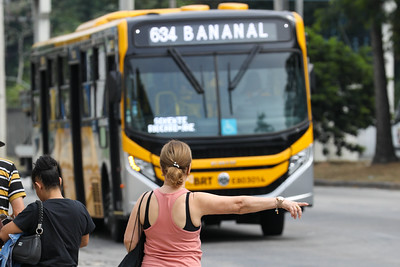
The Gentileza Intermodal Terminal (TIG) is one of the main integration points for public transportation in Rio, bringing together BRT, VLT, and municipal buses, and expanding travel possibilities between the city center and different regions of the city.
Gentileza is one of the main terminals of the Transbrasil BRT, allowing connections via Avenida Brasil to the North and West Zones. The services that serve the terminal are lines 60 (Deodoro – Gentileza), 61 (Deodoro – Gentileza, express), 70 (Metropolitan BRT Terminal – Gentileza), 73 (Metropolitan BRT Terminal – Gentileza, express), 80 (Penha – Gentileza), 90 (Fundão – Gentileza), in addition to the direct executive service Galeão – Gentileza.
By light rail, lines 1 and 4 connect Gentileza Airport to strategic points in the city center and the port area. Line 1 connects the terminal to Santos Dumont Airport, passing through the Praça Mauá area and the Museum of Tomorrow. Line 4 goes to Praça XV, connecting to Central do Brasil train station and the ferry terminal.
The terminal is also served by 26 municipal bus services, including regular and nighttime operations, connecting to neighborhoods in the South, North, and West zones. From Gentileza, it is possible to go directly to areas such as São Conrado, Leblon, Ipanema, Copacabana, Urca, Cosme Velho, Engenho de Dentro, Marechal Hermes, and Gardênia Azul, as well as the Alvorada Terminal in Barra da Tijuca.
With this integration, the Gentileza Terminal functions as an important gateway to the central region of Rio, facilitating access for passengers coming from different areas of the city and also from the Baixada Fluminense.
Jaé Integrations
Rio de Janeiro Single Ticket (BUC)
It allows passengers to make up to three trips between municipal modes of transport — bus, BRT, light rail, and vans — within three hours, paying a single fare of R$ 5, provided that one of the trips is made on the BRT. Without the BRT, the integrated fare allows for two trips.
Margaridas Single Ticket (BUM)
Available to passengers on 11 intercity bus lines using the Metropolitan BRT Terminal, it allows up to four trips between BRT, light rail, and municipal buses within 20 hours, with municipal integration for the price of R$ 5.
Currently, the Metropolitan BRT Terminal is served by intercity bus lines originating from six municipalities in the Baixada Fluminense region: Nova Iguaçu, São João de Meriti, Mesquita, Nilópolis, Belford Roxo, and Queimados.
Samba Light Rail
The VLT Carioca will also be part of the Rio Art Week program with a special event on September 19th, bringing samba and popular music inside a train on Line 3 (Central x Santos Dumont).
The event, scheduled to begin at noon, will feature Marquinhos de Oswaldo Cruz and his band. During the journey, the artists will perform samba and popular music, continuing to Santos Dumont and then to Candelária, where the group will disembark to proceed to the Feira das Yabás, which will be held at the CCBB.
The train will continue operating regularly, without service interruption, and passengers will be able to board and disembark as normal. The concessionaire will reinforce its service and inspection teams to support the operation.
The estimate is approximately 70 people, including guests, artists, production team, and participants in the event, who will be identified by wristbands.
Metro Operation
The subway will also be an option for reaching the venues of Rio Art Week. The system will operate from Monday to Saturday, from 5 am to midnight, and on Sundays, from 7 am to 23 pm.
To facilitate boarding, the recommendation is to use contactless payment methods or to purchase and top up Jaé and Riocard cards in advance.
Public Order will be involved in patrolling and monitoring.
The Municipal Secretariat of Public Order (Seop) will be involved in urban planning actions, preventive patrolling, inspection of street vendors, and irregular occupation of public areas, as well as combating illegal parking in various parts of the city during Rio Art Week.
Agents are already acting preventively in the city center, Cinelândia, Gamboa, Glória, Lapa, Praça Mauá, Praça XV, and Santa Teresa. The special plan for the 11 days of events will involve 825 agents spread across various points in the city, ensuring urban order and assisting in guiding locals and tourists. In addition, the operation will have the support of 17 vehicles, including cars and motorcycles, as well as 5 tow trucks.
The following items are prohibited from being brought into the event spaces:
Glass bottles
Sharp objects
Fireworks or incendiary devices
Firearms or bladed weapons
Unauthorized marketing materials
SEOP teams will be inspecting access areas to events, focusing on seizing prohibited items.
The Municipal Guard will deploy reinforced personnel, prioritizing traffic and urban security.
The special operation by the Rio de Janeiro Municipal Guard (GM-Rio) for Rio Art Week will involve 681 municipal guards, with 141 dedicated to traffic monitoring and enforcement, supported by 29 vehicles, including 10 motorcycles. The actions will prioritize urban and road safety across the eight circuits and more than 400 mapped cultural venues.
From September 14th to 29th, the Municipal Guard will be conducting preventative patrols two days before and after the events, a period when the public leaves the city. The municipal guards will focus on urban and road safety, ensuring the well-being of the public and providing general assistance to the population. The teams will act preventively to combat crimes and traffic violations that may pose risks to those participating in the cultural events.
COR-Rio will mobilize 250 operators and nearly 900 cameras to monitor the city.
The Operations and Resilience Center (COR-Rio) will monitor public movement and traffic during Rio Art Week. A total of 894 cameras will be used to monitor the streets of the central region and the main circuits of the program, including Marina da Glória-MAM, Capanema-Cinelândia, Lapa-Rua do Senado, Santa Teresa, Tiradentes, Praça XV-Beco do Bragança, Praça Mauá, Gamboa, Praça Onze and Carioca, among others.
The movement of people and vehicle traffic will be monitored directly from the COR-Rio headquarters in Cidade Nova. In the Situation Room, a daily staff of approximately 250 on-call operators from various public agencies and concessionaires will monitor the activity at the event locations.
Monitoring will also be done via the COR-Rio video wall, the largest in Latin America, a 104-square-meter digital panel composed of 125 55-inch screens.
News
Rio operates with weekday bus fleet this Sunday of the election.
October 4th, 2026
City Hall announces works to combat flooding in downtown Campo Grande.
October 3th, 2026
Construction begins on the new Campo Grande Intermodal Terminal.
October 2th, 2026