





Category:
City Hall sanctions Neutral ISS Law that encourages the voluntary carbon credit market
Published on 12/06/2023 - 13:29 | Updated on 12/06/2023 - 16:56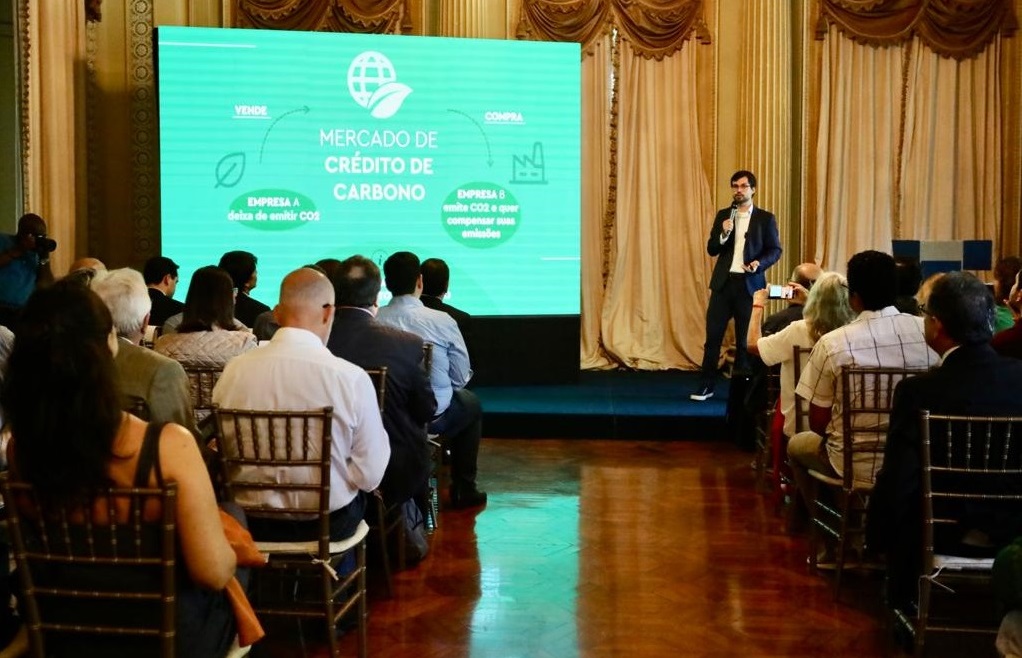 The law creates tax incentives for companies in the carbon credit chain to set up in the city - Beth Santos/City Hall of Rio
Rio Mayor Eduardo Paes, accompanied by the Secretary of Finance and Planning, Andrea Senko, and the Secretary of Economic Development, Innovation and Simplification, Chicão Bulhões, sanctioned the Neutral ISS Law on Monday (12/06). Authored by the Executive, Law No. 7907/2023 created tax incentives for companies in the carbon credit chain to set up in the city. The city expects to provide R$60 million per year in incentives that can be deducted from the ISS of carbon credit buyers. This amount corresponds to 1,2% of the approximately US$1 billion traded in the global voluntary carbon market, considering 2021 data.
To make the initiative viable, the law provides for a reduction, from 5% to 2%, of the rate of the Tax on Services of Any Nature (ISS) that applies to activities involving the development and auditing of carbon credit projects, in addition to activities involving the registration of carbon credits and the provision of carbon credit transaction platforms.
– We must make a permanent effort to identify the potential of our city. Since the beginning of the government, we have been observing which sectors we can attract, creating the best conditions for the private sector to develop here. When we hold a Web Summit, when we create legislation to stimulate innovation, it is because we understand that a significant part of Brazilian intelligence is in the city of Rio. I have no doubt that this is a sector that the city needs to stimulate, encouraging Rio to become the capital of energy. The environmental issue in Rio goes beyond sustainability aspects because here it is also an economic aspect. People and companies decide to live and invest in Rio, or they decide to leave here, if the economic assets are not treated appropriately – stated Eduardo Paes.
The aim of the new law is to transform the city of Rio into the capital of green investments, in addition to meeting the goals set out in the Rio 2021-2024 Strategic Plan. The measure will also help achieve the goals of the Sustainable Development and Climate Action Plan, to neutralize CO2 emissions – 5% by 2024, 20% by 2030 (both in relation to 2017), and to be carbon neutral by 2050.
– This is a historic law not only for the city of Rio, but for Brazil. This is the largest incentive package to date for the carbon credit market, especially the voluntary market. We do not yet have a regulated market; we are waiting for Congress to regulate it. We are lowering taxes for those who operate in this market and attracting them to Rio. We have set aside R$60 million for any economic activity that uses the voluntary market to buy carbon credits so that companies can offset them. The City Hall will publish the rules in a notice in July explaining how companies can request exemption – explained Chicão Bulhões.
The incentive will be temporary and will remain in effect until the end of 2030. The law also provides that the efficiency and effectiveness of the benefits granted will be assessed annually, in accordance with annual performance criteria and targets.
– This is yet another action that reinforces Rio’s vocation to be the green capital of the country. With the creation of ISS Neutro, our goal is to encourage the installation of the carbon credit market in the city of Rio and also to encourage other companies to be willing to neutralize carbon emissions – stated Andrea Senko.
Deputy Director of the Alberto Luiz Coimbra Institute of Postgraduate Studies and Research in Engineering (COPPE), at UFRJ, Suzana Khan highlighted the importance of the initiative to create the Neutral ISS Law.
– I believe that today there is no doubt about the risks of global warming. All initiatives that encourage the reduction of these emissions are very important. Rio de Janeiro, having led the climate agenda with the world climate conference in 1992, should play this leading role. What the city of Rio does has repercussions around the world. Innovative measures like this send a very important signal about all the ways we can reduce greenhouse gas emissions. When you offer an economic advantage, such as tax reductions, you make activities migrate to those with less environmental impact. And it signals the importance that the government places on making these measures happen – stressed Suzana.