





Category:
New BRT model is presented. Buying buses is part of the restructuring of the system
Published on 27/09/2022 - 14:01 | Updated on 25/02/2024 - 12:31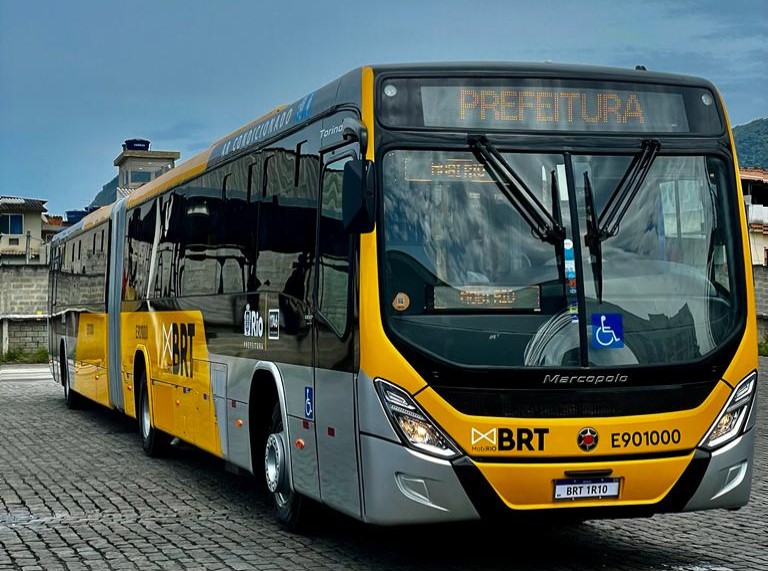 The new BRT model has had its visual identity redefined in yellow and silver and is more modern - Beth Santos/City Hall of Rio
Rio Mayor Eduardo Paes, Transport Secretary Maína Celidonio and Mobi-Rio President Claudia Secin presented the new bus model that will be used in the BRT system. With a redefined visual identity in yellow and silver and more modern, the articulated vehicle was presented on the morning of Tuesday (27/9) at the BTR garage in Curicica, in the West Zone.
– It is a great pleasure and joy to receive the first bus. We know that the population is suffering and, unfortunately, it is not easy to acquire new buses. In the first week of December, we should have enough to kind of reopen the Transolímpica. Then, in late January and early February, more new buses for the Transcarioca, with all the stations already renovated. The last to receive the new models will be the Transoeste, due to the roadworks. On this route, passengers will have more bus options in the first half of 2023, but will still be operating with the old ones. We hope that, with this, the population will once again have an adequate service and will be able to travel more comfortably – said Eduardo Paes, who appealed to users to be careful and kind with the new buses, because the vehicles were purchased with tax money and damaging them means damaging their own pockets.
In order to accelerate the recovery of the BRT, the Department of Transportation (SMTR) held bids in April and May 2022 for the acquisition of 291 new vehicles for the system, including 220 articulated buses and 71 standard buses. The new vehicles will be delivered between October of this year and March 2023. The City Hall will also bid this year for another 270 articulated buses, with delivery scheduled between October 2023 and March 2024.
The articulated bus presented this Tuesday is from the Brazilian multinational Marcopolo, with a chassis from the manufacturer Volvo and capacity to transport up to 181 passengers. The model has technologies such as a next stop system, with warning through audiovisual devices that alert about the next disembarkation stations, air conditioning, a panic button in the driver's cabin, a driver-passenger communication system with a microphone installed in the driver's cabin, an audible warning when the boarding and disembarking doors close, and USB sockets in all seats.
The new model also features closed-circuit TV that allows the driver to view images from the vehicle's internal cameras. The new BRT consists of a panel that shows the vehicle's speed, a private cabin for the driver, a reversing camera and a unique lighting system with chromotherapy inside the vehicle.
– We planned a fleet to provide comfort to the population, to eliminate overcrowding, with a very high frequency of buses. The new models have three accessibility ramps and more seats for these people – said Maína Celidonio.
Restructuring of the BRT system
The Rio de Janeiro City Government has been working to make the BRT system more efficient since last year, when it took over management of the system. In total, 46 stations that were closed were renovated and reopened, in addition to another 23 that were remodeled. Among other projects, there is the ongoing construction of the BRT Transbrasil, which will have 18 stations and four terminals, including the Gentileza Intermodal Terminal, which will integrate the BRT with the VLT and municipal bus lines.
The resurfacing of the Transoeste corridor and the remodeling of five stations and terminals are also underway: Santa Cruz, Curral Falso, Pingo D´Água, Magarça and Mato Alto. Five bus garages, located in Paciência, Curicica, Cascadura, Ramos and Deodoro, will also undergo improvement and expansion works to accommodate the new BRT fleet.
Recently, two occasional services (Alvorada x Madureira and Alvorada x Penha) were created in the Transcarioca corridor, with 38 rented articulated buses. These services join the others already in operation in Transoeste, which already have 101 rented urban buses. The City Hall also began hiring station operators, who will receive training from the BRT Seguro program, of the Secretariat of Public Order (SEOP), to monitor and fine the illicit practice of fare evasion in the BRT system.
– The City Hall is working to restore comfort and quality to passengers on the BRT system. We are renovating stations and offering additional services to ease demand until the new buses start operating – said Mobi-Rio president Claudia Secin.
Digital Ticketing will start on BRT
The bidding process for the new digital ticketing system is underway and will allow the City Hall to control public transportation revenue, ensuring transparency. The contract is scheduled to be signed in October of this year and operations are scheduled to begin in April 2023, starting with the BRT. The digital ticketing system is expected to begin operating in other municipal transportation methods, such as VLT, conventional buses, and vans, by early 2024. The concession will be valid for a period of twelve years, with the possibility of being extended for a maximum of the same period.