





Category:
City Hall announces anti-rabies vaccination for dogs and cats and opens registration for employees who want to work on the campaign
Published on 20/08/2020 - 11:32 | Updated on 21/08/2020 - 14:24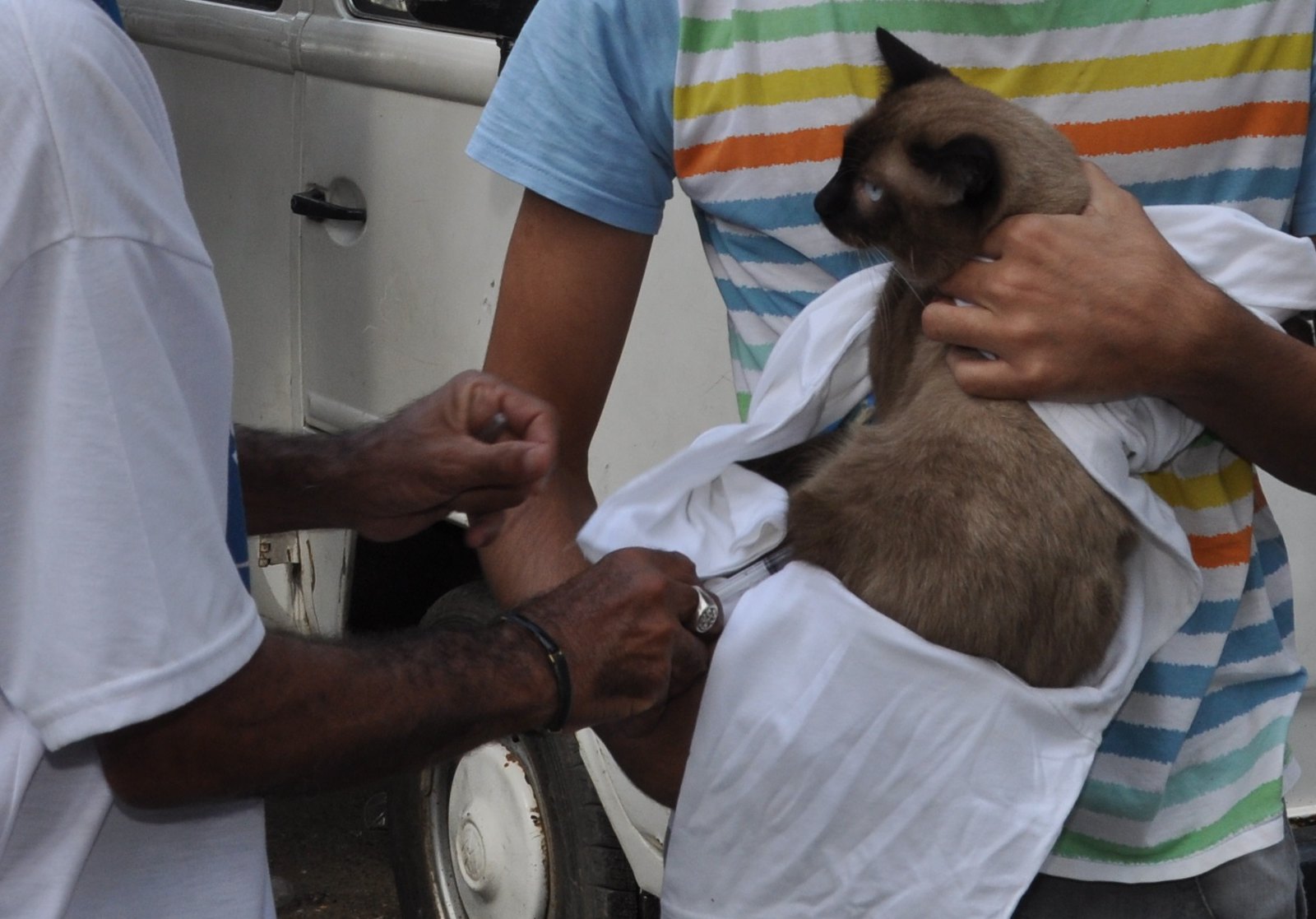 Cat is vaccinated in the campaign against rabies. Photo: Rio City Hall
The Rio de Janeiro City Hall, through the Subsecretariat of Surveillance, Health Inspection and Zoonosis Control, will carry out an anti-rabies vaccination campaign from October to December 2020. To this end, the department, linked to the Municipal Health Department, opened registrations from this Thursday (August 20) until September 08 for municipal employees who want to work as vaccinators in the program “Se liga, bicho! Rabies is a serious case”. The call was published in the Official Gazette on Wednesday (August 18). Employees with various backgrounds, education levels and from any department of the direct administration can participate, except for employees of the indirect administration, such as Comlurb, Municipal Guard and other autarchies.
Those interested should seek out a health unit to get vaccinated against human rabies and take a serology test, which shows that the person already has antibodies against the disease, aiming at protection in case of accidents. Qualified employees will undergo training and will be summoned in the Official Gazette. All those who participate in the campaign, with proof of attendance in the attendance list, will receive charges for their work.
How to sign up to participate in the campaign
To register, simply send an email to zoonosespcrj@gmail.com, providing your full name, registration number, department of employment and contact telephone numbers, as well as attaching copies of your last pay slip and identity card.
— It is essential to vaccinate dogs and cats against rabies annually. Since we have vaccinated around 1 animals in the last two years, the goal this year is to vaccinate at least 500 at fixed and itinerant locations, which will be announced soon. Taking, of course, all precautions to prevent Covid-19 — emphasizes veterinarian Márcia Rolim, deputy secretary of Health Surveillance of Rio.
The animal anti-rabies campaign is carried out with the vaccine distributed by the Federal Government to the states, which then pass it on to the municipalities. In 2019, however, the input was not delivered, making the campaign unfeasible. Even without the transfer of vaccines, the city of Rio immunized more than 33 thousand animals last year with the technical reserve of doses from the 2018 campaign. In 2020, the Health Surveillance Agency started the year with around a thousand vaccines kept in stock, for the need for perifocal work, which are preventive actions in which the City Hall promotes vaccination in regions where there are cases of contaminated bats.
Rabies is a fatal disease for both animals and humans. An example of this is the case of a 14-year-old teenager who died on March 30 after being bitten by a bat and contracting rabies in Angra dos Reis. This was the first recorded death from human rabies in the state of Rio since 2006. In relation to the municipality, there has been no occurrence of human rabies since 1986 (34 years ago) and no cases of the disease in dogs and cats since 1995 (25 years ago). All data related to the prevention and control of the disease are updated and made available on the Health Surveillance website.